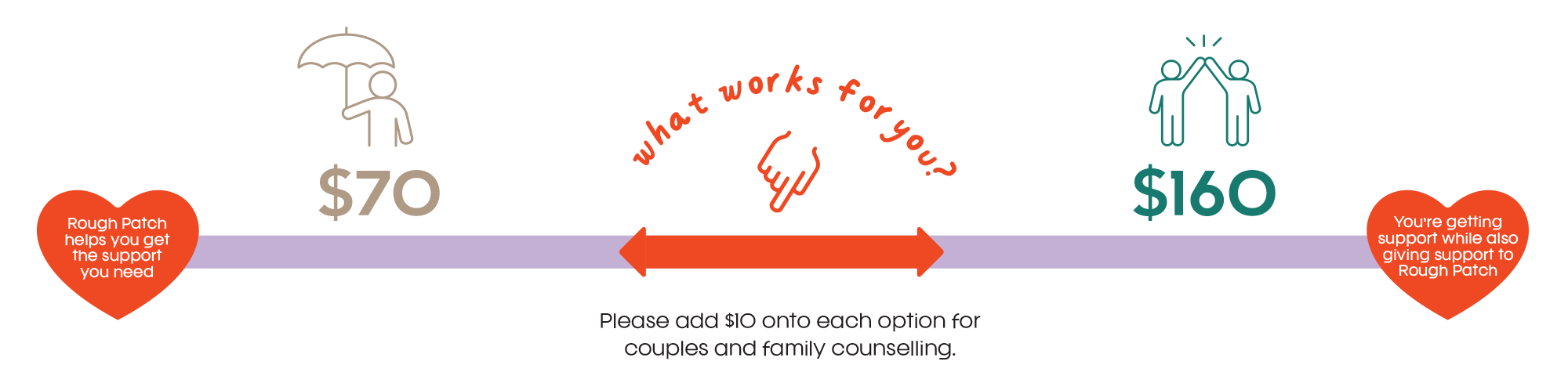
Rough Patch is an Australian not for profit counselling service helping people access affordable mental health support. Whether you’re navigating anxiety, grief, relationship challenges, trauma, parenting, neurodivergence or major life changes, our experienced counsellors offer sessions from $70 to $160 through our sliding scale fee model. Browse the directory below or take our matching quiz to find the right counsellor for you.




There are some people that our counsellors can’t work with – not because we don’t want to, but because we want you to have the best possible care.
If you currently experience domestic violence, are having a mental health crisis, are experiencing severe substance dependency issues, or other acute crises, we can’t provide you with the level of support you deserve. However, we will use your initial appointment to connect you with places that specialise in these issues, so you can get the best possible care.
All Rough Patch counsellors manage their own scheduling and administration. Click on a profile to read more and send an email enquiry. In the rare event you don’t hear from a counsellor within 24 hours, please call us on 02 7226 0809
All of our counsellors generously reduce their usual fees to provide affordable mental healthcare to our community. They do not receive government rebates or funding to provide their services.
Unfortunately, the Australian government does not allow counsellors, psychotherapists and some social workers to offer Medicare rebates.Our sliding scale model ($70-$160 per session) is designed to make counselling affordable and accessible without relying on government rebates or insurance claims.If you have questions about payment options or choosing your session fee, you can discuss these in your initial assessment session with your therapist.
Rough Patch exists to support people who can’t ordinarily afford the cost of counselling.
Our experienced, professional counsellors reduce their usual fees to provide clients with the counselling and support they need. In turn, Rough Patch provides room hire at a significantly lower rate than other clinics. This means counsellors can charge their clients less, making counselling more affordable.
To keep waitlists short, clients are able to access up to 30 sessions per 12 month period. If more sessions are needed, the counsellor will work with you to find longer-term supports. This guide is to help you decide your fee for counselling at Rough Patch. Each person’s situation is unique, so this is a guide only. Your counsellor will discuss fees with you during your first session.
Together, you decide the appropriate fee for your sessions based on your circumstances.
People come to counselling for many different reasons. Some are navigating a specific challenge, while others simply want support making sense of what they’re experiencing. At Rough Patch, our counsellors support people from all walks of life through life’s ups, downs, and everything in between.
Common reasons people reach out include:
Not sure where your experience fits? Our matching quiz can help connect you with a counsellor who aligns with your needs.
Finding the right counsellor can feel overwhelming, especially when cost is already a barrier to getting support. Rough Patch was created to make professional counselling more accessible, connecting people with experienced counsellors who are committed to providing affordable mental healthcare.
What makes Rough Patch different:
We believe everyone deserves access to quality mental health support, regardless of their circumstances or income.
All potential clients are required to complete an assessment session with the counsellor of their choice.
This session ensures that the Rough Patch approach will work best for you, and is conducted online via a videoconferencing platform such as Zoom.
Please note that due to the limitations of our reduced-fee model and the busy schedules of our counsellors, we cannot offer free discovery phone calls prior to your assessment session.
During your intake session, your counsellor will:
If you or the counsellor determine that Rough Patch isn’t the best fit, they will provide alternative ideas and referrals to other services who may be able to support you. Initial sessions are always $70 for an individual or $80 for a couple and are non-refundable, regardless of whether you continue counselling with a Rough Patch counsellor.
This fee covers the cost of the counsellor’s time, including the session itself and any additional work they do to ensure you receive appropriate referrals or support.
Take a look at our counsellor profiles here and see who might be a good fit for you.
Email your preferred counsellor to book an initial appointment.
Please note that due to busy schedules, our counsellors can’t do phone intakes. Initial appointments are $70 ($80 for couples) and are used to discuss your goals and determine if it’s a good match. If not, we can refer you to someone else – no hard feelings!
It’s important to remember we can’t work with clients experiencing domestic violence, mental health crises, severe substance dependency, or other acute issues. We want you to have the best care, so we’ll use the initial appointment to connect you with specialized services if needed.
Not sure who to choose? Call us at 02 7226 0809, and we’ll be happy to help.
Rough Patch offers affordable medium-term counselling and mental health services, of up to 30 sessions in a 12-month period. We do this so we can increase access for anyone who needs us without long waiting lists. You’re welcome to come back for another round of counselling after 12 months, if you like.
Medium-term counselling is a great way of getting support and looking at some of the things in your life that cause distress, worry or other difficult feelings. We can find you a counsellor who has experience working with whatever it is you want to address, including depression, anxiety, stress and worry, relationship, family and parenting difficulties, childhood issues, work and professional issues, and communication difficulties. We have counsellors who specialise in helping people who have experienced violence, sexual assault, disordered eating, and addictions in the past.
You’ll be able to do great things in 30 sessions, but might find you want to continue counselling to get even more benefit. For some people, medium-term counselling won’t be long enough to address trauma, complex issues and healing, and that’s totally normal. If this is the case for you, your counsellor will work with you to find longer-term supports.
We want to support anyone who might need us, but having said this, we aren’t a crisis centre or specialised service. We won’t be able to provide the necessary support you if you currently experience domestic violence, are having a mental health crisis, are experiencing severe substance dependency issues, or other acute crises. We will happily connect you with the places that specialise in these issues, so you can get the best possible care.
There are some people that our counsellors can’t work with – not because we don’t want to, but because we want you to have the best possible care.
If you currently experience domestic violence, are having a mental health crisis, are experiencing severe substance dependency issues, or other acute crises, we can’t provide you with the level of support you deserve. However, we will use your initial appointment to connect you with places that specialise in these issues, so you can get the best possible care.
Unfortunately, we cannot offer you counselling sessions if you do not currently reside in Australia. This is for safety and insurance purposes, but also because our focus is on increasing access and bridging gaps in the Australian healthcare system.
Note that you do not have to be an Australian citizen or visa holder to access our service, but you must currently live here.
A referral service simply means we will use our expertise and resources to connect you with another healthcare provider depending on your need. This might include speciality counselling services, GPs, psychiatrists, psychologists, or other businesses and organisations that can help with counselling, advocacy, or health care.
To put it simply, all four practitioners aim to help people with emotional distress and improve mental health. However, their training and approaches differ.
A psychiatrist is a medical doctor who completes their training and then goes on to specialise in mental health medicine. They can diagnose mental illnesses, prescribe medication, and usually only see their patients for 30 minutes or so. Some psychiatrists are also counsellors, and see their patients once a week for a longer session, but this isn’t very common.
Psychologists complete varying degrees and can specialise in neuropsychology, forensic psychology, educational or developmental psychology, sport and exercise psychology, or counselling psychology. Sometimes, psychologists don’t see clients for counselling, but do things like psychology research or teaching. A Clinical Psychologist specialises in the assessment, diagnosis and treatment of mental health issues.
If you are experiencing extreme mental distress/illness and require a high level of support and mental health care, if you require any assessments or reports for criminal or family court, or generally speaking need a high level of care or specific expertise, a psychologist may be the best support for you.
Social Workers work in many different contexts, such as case work, advocacy, community work, social action, policy development, and education. Counselling Social Workers see clients for counselling, case management and advocacy and tend to be more hands-on with helping people get supports they need from government agencies such as housing, employment, disability support, etc.
Counsellors and psychotherapists have varying levels of training and approaches. Some counsellors and psychotherapists study for many years to complete Bachelors, Masters and Doctoral degrees, and some do not have university degrees at all, although this is uncommon. Unfortunately, counselling isn’t regulated as heavily in Australia as psychiatry, psychology and social work. However, most counsellors are committed to ongoing learning and development, and have a unique approach because of their varied and eclectic training methods.
All Rough Patch counsellors are registered with a professional association, which means they are required to meet strict standards every year, including a certain amount of training, professional development, supervision and learning. They are bound by a code of conduct and ethics which they are required to uphold for their professional registration. All Rough Patch counsellors have a minimum of a Bachelors Degree in counselling or a related field.
At Rough Patch, regardless of a practitioner’s training, approach or registrations, they all work within our model and provide counselling for $70-$160 per individual session, or $80-$170 per couples/family session.
Research shows that online counselling can be just as effective as in-person therapy for many issues. It offers convenience and accessibility while maintaining the quality of care.
You’ll need a device with a camera and microphone (computer, tablet, smartphone), a stable internet connection, and a private, quiet space for your sessions.
We strongly recommend using a computer wherever possible.
Your counsellor can provide technical support before and during sessions. If issues persist, we can switch to a phone session or reschedule.
Online counselling is suitable for many mental health issues. However, complex mental health experiences may require in-person treatment. We’ll assess your needs during the initial consultation and recommend the most appropriate care.
Our experienced, professional counsellors reduce their usual fees to provide clients with the counselling and support they need. In turn, Rough Patch provides professional supports to counsellors at a significantly lower rate than other clinics. This means counsellors can charge their clients less, making counselling more affordable.
To keep waitlists short, clients are able to access up to 30 sessions per 12 month period. If more sessions are needed, the counsellor will work with you to find longer-term supports.
Unfortunately, the Australian Government only offers rebates to clients of psychologists and some social workers. Our unique model does not rely on Medicare and still costs less per session than many psychologists, even after the rebate.
We currently do not have any counsellors who are registered as NDIS providers, but we’re working towards this. However, depending on your NDIS plan, you may be able to engage with an NDIS provider outside of Rough Patch who can arrange brokerage or pay for your counselling sessions through their organisation. We recommend speaking to your NDIS Support Coordinator for more details – we’re happy to liaise with them where helpful.
Some counsellors in Australia are registered with private health insurers (such as HCF, Bupa, Medibank Private, etc), which means these insurers may offer rebates on counselling services under your policy’s extra’s cover. Counsellors are only eligible register as providers with these companies after a certain number of years in practice, and not all counsellors choose to register even when eligible. Given our fees are already significantly reduced, Rough Patch does not offer rebates through health insurance.
A social enterprise is a business that uses its revenue to improve communities, the environment or contribute positively to social wellbeing and advancement. For-profit businesses give their shareholders, including the owners, dividends of the profit made. In non-profit organisations, profits are reinvested and dividends are distributed to the community in the form of services, programs, employment and other resources. A social enterprise strengthens the community by providing a service that benefits everyone.
A non-profit social enterprise is not a registered charity. There are no tax breaks for the business, and they are not eligible for government funding in the same way charities and non-government organisations are.
At Rough Patch, we reinvest any profit back into the business to provide further affordable counselling and mental health supports to those who need us.
Traditionally, mental health services in Australia are either full-fee, for-profit businesses which charge up to $250 per hour, or free services which are funded by faith-based charities or government departments. Often, the waitlists for free services are very long, and the organisations that provide them are underfunded, overstretched, and pay their counsellors a very low wage. They are also often faith-based organisations which isn’t the right fit for many people. At the other end, for-profit businesses charge high fees which aren’t affordable for many people, and generally only attract a partial Medicare rebate for a maximum 10 sessions per year.
Rough Patch provides a solution that sits somewhere between these two extremes. By offering a service that is subsidised by sales from our shop, by revenue from training, consulting to other health practitioners, organisations and businesses, and through donations and grants, Rough Patch provides counselling that is both affordable and accessible.
Absolutely. We firmly believe that mental health care is a basic human right, not a privilege determined by citizenship status. We welcome everyone regardless of their legal standing in Australia.
Because we do not receive any government funding, your details are not recorded on any government databases and we do not share your data with any other organisations.
As with other countries around the world, many Australians experience a range of mental health difficulties.
One in five (20%) of Australians aged 16-85 experience mental health difficulties every year. (1)
The most common mental health issues are depression, anxiety, and substance use, which often occur at the same time. (1)
Almost half (45%) of Australians will experience mental health difficulties at least once in their life. (1)
Over half (54%) of people with mental illness do not access treatment. (2)
People who do access treatment recover more quickly and have better mental and physical health outcomes. (4)
Health professionals are at greater risk of anxiety, depression and suicide. (3)
Early intervention reduces suffering, improves mental and physical health outcomes, and costs less. (5)